• Welcome to your new Gnomio site

    Now, you are in control!

    Moodle is an open-source Learning Management System (LMS) that provides educators with the tools and features to create and manage online courses. It allows educators to organize course materials, create quizzes and assignments, host discussion forums, and track student progress. Moodle is highly flexible and can be customized to meet the specific needs of different institutions and learning environments.

    Moodle supports both synchronous and asynchronous learning environments, enabling educators to host live webinars, video conferences, and chat sessions, as well as providing a variety of tools that support self-paced learning, including videos, interactive quizzes, and discussion forums. The platform also integrates with other tools and systems, such as Google Apps and plagiarism detection software, to provide a seamless learning experience.

    Moodle is widely used in educational institutions, including universities, K-12 schools, and corporate training programs. It is well-suited to online and blended learning environments and distance education programs. Additionally, Moodle's accessibility features make it a popular choice for learners with disabilities, ensuring that courses are inclusive and accessible to all learners.

    The Moodle community is an active group of users, developers, and educators who contribute to the platform's development and improvement. The community provides support, resources, and documentation for users, as well as a forum for sharing ideas and best practices. Moodle releases regular updates and improvements, ensuring that the platform remains up-to-date with the latest technologies and best practices.

    Links of interest:

    (You can edit or remove this text)

Available courses

Welcome, Dear Final Semester Students,

Good morning!

It’s a genuine pleasure to welcome you all to this crucial final lap of your M.Sc. journey. You stand at a remarkable point - where the foundational pillars of your degree are set, and now we build upon them to explore one of the most dynamic and powerful tools in theoretical physics.

This semester, we embark on the Quantum Theory of Scattering.

Think of it as the sophisticated sequel to your quantum mechanics course. We’ve learned how particles exist in potentials; now we learn how they talk to each other and to the world. Scattering is the universal language of interrogation in physics - from probing the structure of an atom to deciphering the collisions at the LHC. We will move from the elegant formalism of Lippmann-Schwinger equations to the practical power of partial wave analysis and Born approximations.

I understand the unique pressures and aspirations of this final semester. My goal is to ensure this course is not just another subject, but a key that unlocks deeper understanding for your projects, your future research, and for viewing the physical world through a more complete lens.

The path is challenging, but it is immensely rewarding. I am here to guide you through it. Let’s begin this exploration together, with curiosity and rigor.

See you in the classroom, as well as in actively participating in your MOODLE of this course!

Binil Sir

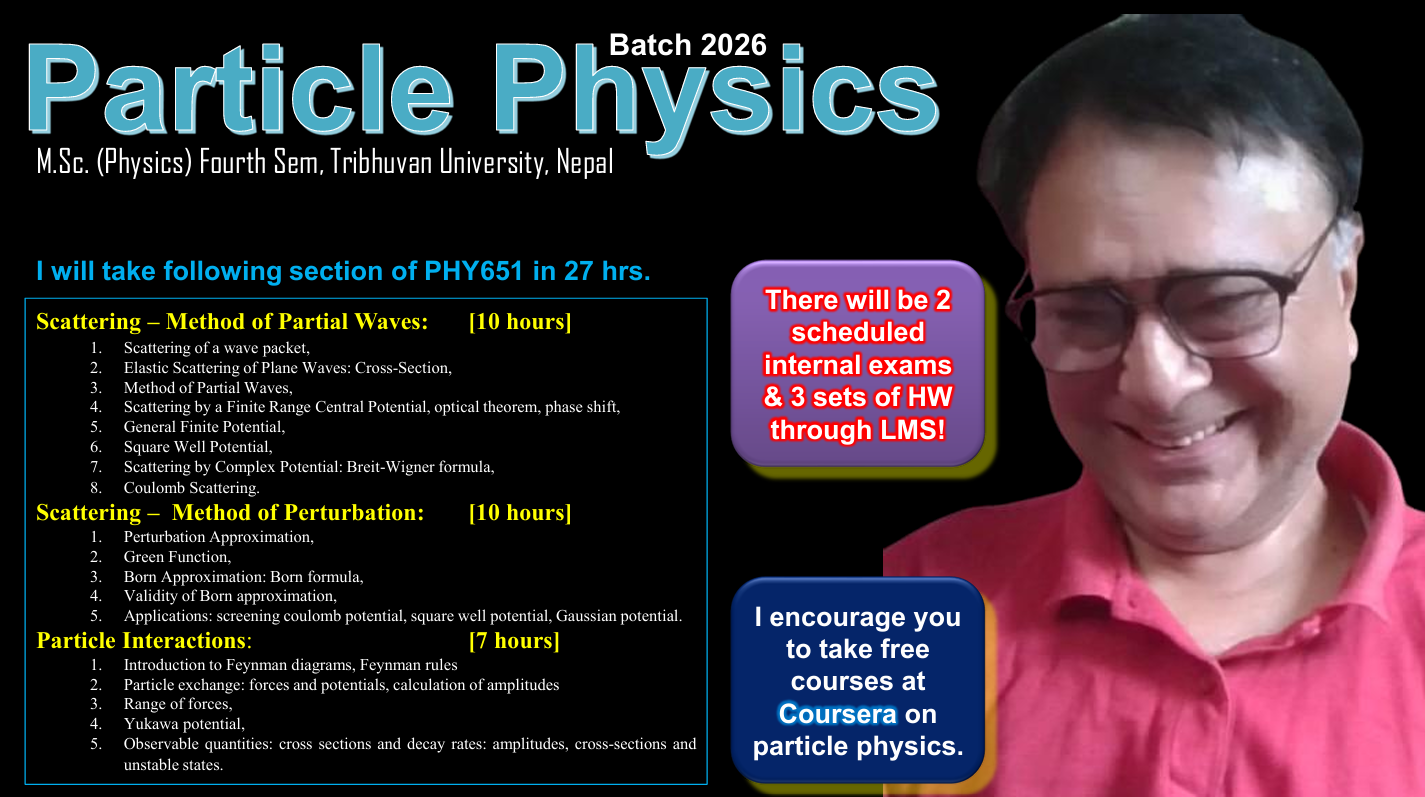
This course deals rigorous understanding of Quantum Theory of Scattering. I will facilitate my students to learn scattering by 'Perturbation Method' and 'Particial Wave Method' in coming 3 months. I will try my best to involve all of my students in the LMS. 

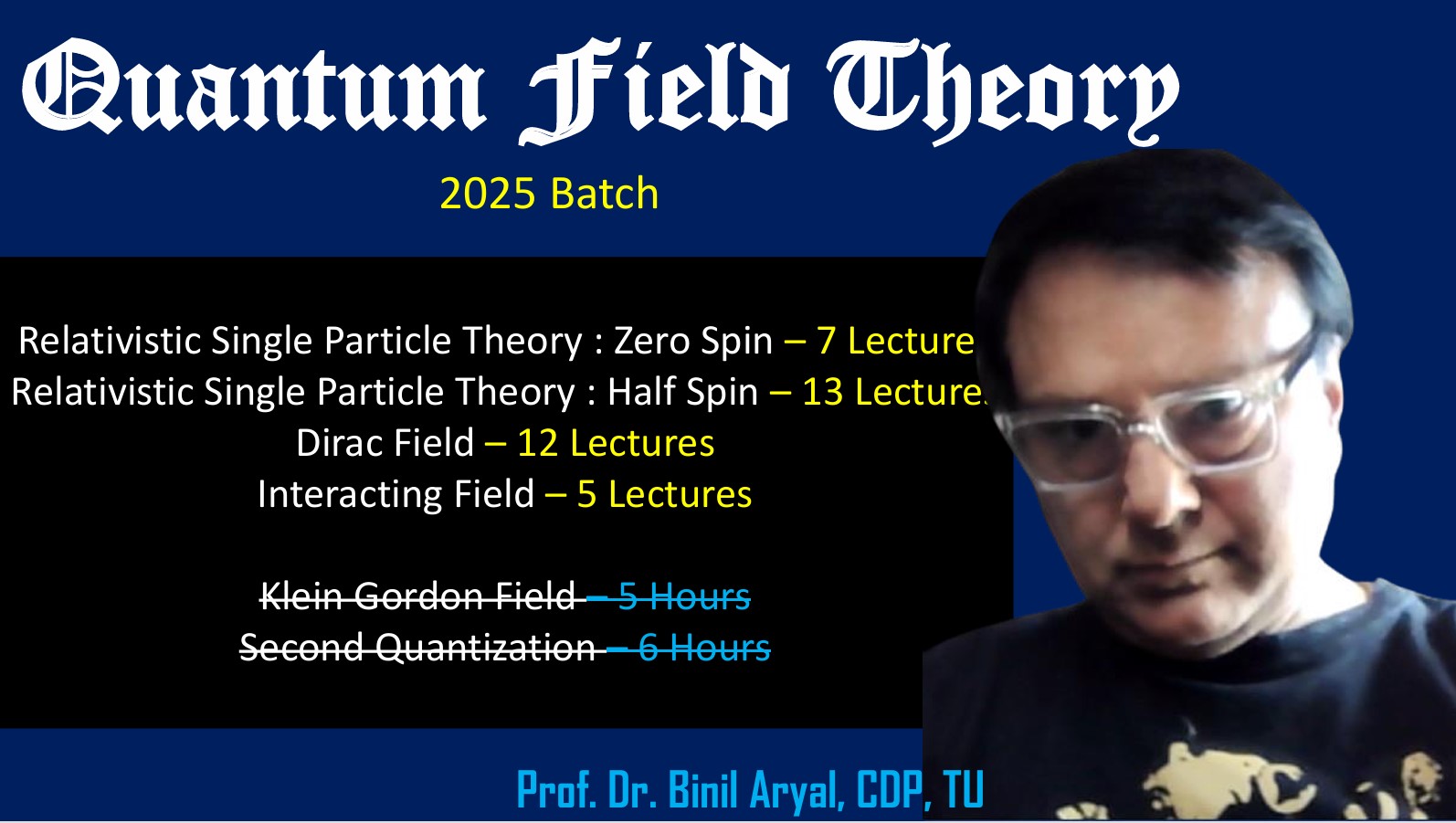
This course deals relativistic part of quantum mechanics leading field theory for quantum world. The main focus of this course to discuss the Dirac Equation and its implications to many unsolved issues.